REVIEW · PRAGUE
3-hour Private Prague Castle Walking Tour
Book on Viator →Operated by Lucytours · Bookable on Viator
Prague Castle can feel like a maze. This private 3-hour route helps you read the place fast, with stops like St Vitus Cathedral and the Old Royal Palace, plus Golden Lane and Daliborka. The trade-off: a few interior areas can be affected by services, openings, or on-site construction, so timing can shift a bit on the day.
What I like most is the way the guide controls the visit. With an English-speaking guide, you get a route that moves at a human pace and gets you through the busy parts with less waiting—exactly what you want when you only have a slice of time.
You start at Archbishop Palace 16 in Hradčany and usually end in Klárov, which makes the wrap-up easy if you’re continuing through Malá Strana after.
In This Review
- Key highlights you’ll feel right away
- A private Prague Castle walk fixes the big problem: time
- Pricing and value: what $169.38 buys you (and what it doesn’t)
- Start in Hradčany, finish in Klárov: logistics that keep you sane
- Stop by stop: what you’ll actually see and why it’s worth your time
- Prague Castle complex: the whole kingdom in one walk
- St Vitus Cathedral: coronations, burials, and real-time timing issues
- Old Royal Palace (plus the palace world around it)
- Golden Lane: small lives, big atmosphere
- St George’s Basilica: an early Czech landmark
- Daliborka: the prison that adds bite
- The Lobkowicz family palace and art collections (the cultural contrast)
- How guides make the difference: pace, questions, and crowd-smarts
- What could disappoint you (and how to avoid it)
- You might expect more palaces, but the cathedral takes time
- Schedules and closures can affect interior access
- Price means you should expect real added value
- Who this tour fits best
- Quick practical tips before you go
- Should you book this private Prague Castle walking tour?
- FAQ
- How long is the private Prague Castle walking tour?
- Is this tour private or shared?
- What language is the tour offered in?
- Where does the tour start and end?
- What is included in the price?
- Is food and drinks included?
- Do I need to print anything for the tickets?
- What is the price per person?
- Is there a cancellation option if plans change?
Key highlights you’ll feel right away
- A focused 3-hour plan that targets the biggest Prague Castle hits plus the extras people often skip
- Admission included for key interiors like St Vitus Cathedral and the Old Royal Palace
- Guide-led crowd management so you’re not wandering and losing time in lines
- Golden Lane + Daliborka for the contrast between sweet stories and medieval punishment
- St George’s Basilica with an easy, time-friendly stop at an early Czech landmark
- Customization in real time, often mentioned by name, like guides adjusting pacing and explanations for the group
A private Prague Castle walk fixes the big problem: time
Prague Castle is huge. Not large in a charming way—huge in a I-need-a-plan way. Even if you’ve seen photos, it can still feel like you’re walking through overlapping centuries with no map. This private format solves that by turning the castle into a sequence you can actually follow.
The 3-hour length matters. It’s long enough to hit the major buildings and still add a couple of high-value side stops, but short enough that you’re not stuck until your feet file a complaint. And because it’s private, the guide can set the pace for your group instead of marching you through like a lunch line.
Another big win is that the tour is offered in English and includes admission for the castle’s ticketed highlights. That means you spend your energy on the storytelling and architecture—not on ticket booths, guessing entrances, or trying to coordinate your own timing.
You can also read our reviews of more walking tours in Prague



Pricing and value: what $169.38 buys you (and what it doesn’t)
At $169.38 per person, this isn’t a budget add-on. So you should ask: what are you really paying for?
You’re paying for three things that are hard to replicate on your own:
- A guide who can keep your route efficient inside a place where crowds and reroutes happen.
- Context that makes buildings click—you’re not just seeing St Vitus Cathedral, you’re learning why it mattered for Czech rulers.
- Tickets included for major stops, which adds real value when you’re paying entry fees across multiple buildings.
What’s not included is food and drinks. That’s normal for castle tours, but it affects your day planning. If you’re hungry, you’ll want a lunch plan either before or after the tour so you’re not stuck deciding at the last minute.
Finally, there’s a soft value point: this kind of visit tends to book out. On average, it’s booked about 47 days in advance. If your dates are fixed, it’s smart to lock it in sooner rather than later.
Start in Hradčany, finish in Klárov: logistics that keep you sane
The meeting point is at Archbishop Palace 16, Hradčanské nám. 56 (Hradčany). The tour typically ends in Klárov (Malá Strana). That matters more than it sounds.
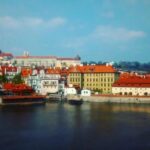
Why? The castle complex sits high above the river. If you finish in Klárov, you’re positioned to keep moving through Malá Strana without spending extra time retracing your steps. It’s one of those small route choices that can save you both time and energy.
You also get a mobile ticket, which is handy in a place where you’ll be checking entrances, gates, and timing. Less paper, fewer questions at the checkpoint.
And yes, it’s private: only your group participates. That’s a big deal if you’ve got kids, slow walkers, or simply people who want more conversation than a standard group pace.
Stop by stop: what you’ll actually see and why it’s worth your time
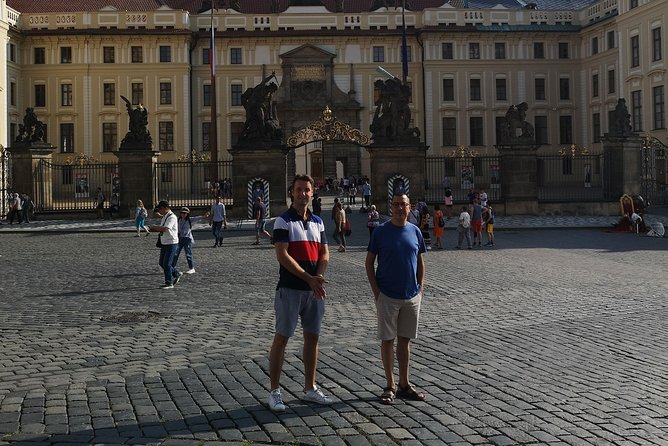
Here’s how the route is designed to work: big landmark first, then the key interiors, then the contrast stops that give the castle texture.
Prague Castle complex: the whole kingdom in one walk
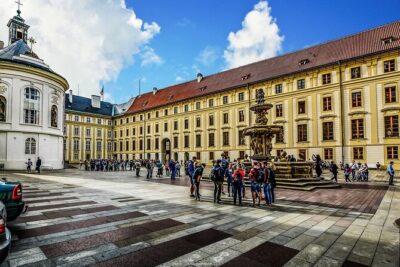
Your first stop is Prague Castle, the largest castle complex in the world, and for much of its history the seat of Czech rulers. This is the moment where a guide can make the scale meaningful.
Without a guide, you might see walls, courtyards, and viewpoints. With a guide, you start understanding how these spaces functioned: authority, residence, ceremony, and the everyday machinery of ruling. That context is what lets St Vitus Cathedral and the royal palace feel connected, not random.
One practical detail: the castle’s crowds can be intense. Multiple guides in past experiences have been praised for timing and routing to help guests spend less time waiting. That’s not magic—it’s planning.
You can also read our reviews of more private tours in Prague






St Vitus Cathedral: coronations, burials, and real-time timing issues
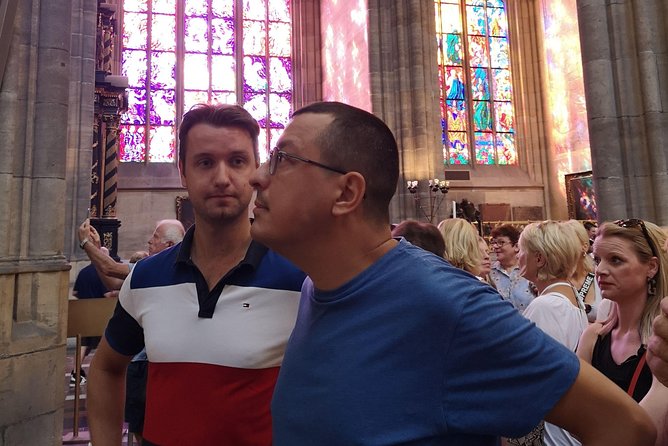
Next is St. Vitus Cathedral, the most important church in Czech history. This is where you’ll hear how it connects to coronations, marriages, and burials of many Czech kings.
The cathedral is also where timing can get tricky. On at least one day, it was briefly closed due to a mass, and the guide returned to the stop after. The point for you: don’t panic if something shifts. A good guide treats the day like a living schedule, not a rigid script.
Also, plan for the cathedral to be a major portion of your “inside” time. If your goal is to see every palace room imaginable, you may feel you want more breadth. But if you want the story backbone of Czech power and culture, this stop earns its weight.
Old Royal Palace (plus the palace world around it)
After the cathedral comes the Old Royal Palace. You’ll visit the interiors where generations of Czech kings lived. This is where you’ll stop thinking of the castle as scenery and start seeing it as a functioning royal machine.
The tour also highlights Wladislav Hall, which is one of those iconic spaces that helps connect the castle’s architectural style to its historical role. Even if you’re not a history nerd, this kind of guided framing helps you understand why these rooms look the way they do.
You may also pass through Rosenberg Palace and the main entrance areas as part of the full route. The castle is full of “half-seen” buildings from street level; a guided walk helps you place each one in the bigger picture.
Golden Lane: small lives, big atmosphere
Then you reach Golden Lane, a picturesque “fairy tale street” where you get the chance to explore how people lived in different eras. It’s a short stop in clock time, but it’s often a memorable one because it feels human-scale compared to the giant courtyards.
Golden Lane is also a strong contrast stop. After ceremonial spaces and royal interiors, this lane helps you imagine everyday people moving through the castle world. It’s the part that tends to make the whole visit feel more complete.
St George’s Basilica: an early Czech landmark
Next is St. George’s Basilica, one of the oldest churches in the Czech Republic, dating back to the 10th century. This is a good “reset” stop. The cathedral is grand and central; St George’s feels older and more intimate in the way it connects to early Czech Christianity and long continuity of place.
It’s also a timed stop designed to fit the 3-hour rhythm. So you’re not losing half the tour to one building.
Daliborka: the prison that adds bite
Then comes Daliborka, a tower linked to one of the harshest prisons in medieval Bohemia. If Golden Lane is the castle’s sweet-side illusion, Daliborka brings the reality check.
This is a great example of why a guided route can be worth it. The architecture alone can read as stone and towers. With context, it becomes a story about confinement, punishment, and how political power could turn into imprisonment.
The Lobkowicz family palace and art collections (the cultural contrast)
The route also includes the private palace of the Lobkowicz family, which hosts art collections. Even when the main castle sights are the draw, this kind of art stop adds a cultural layer that makes the visit feel less like a single theme.
And because it’s part of the guided sequence, it doesn’t feel like you’re being dragged into a random museum detour. It’s more like the castle’s story continues in a different format: art instead of architecture, collections instead of ceremonies.
How guides make the difference: pace, questions, and crowd-smarts
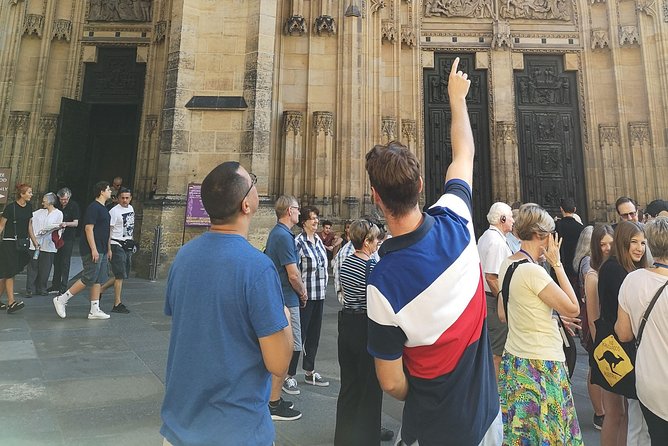
The biggest praise in guides tends to be simple: the day runs well because the guide is actively managing it. You’ll see examples of this through names like Teresa, Pavel, Tereza, Natalia, Matej, Anna, Eva, Gunther, and Jana.
Common threads from these kinds of experiences:
- Customization to your interests and pace (even when the group includes kids).
- Question-friendly time, where you can ask off-script things and still get an answer that fits.
- Efficiency with waiting, often described as routes that minimize line time.
- Smart day planning for weather, shade, and timing.
Some guides also share practical local tips beyond the castle itself—things like where to eat, what to see next, or how to get around. You shouldn’t expect that as a guarantee, but it shows up often enough to be worth mentioning.
If you’re going in summer, one practical recommendation that comes up is to start early (for example, a 9am start was suggested to reduce crowd heat and congestion). If you want the simplest strategy: aim for mornings when possible.
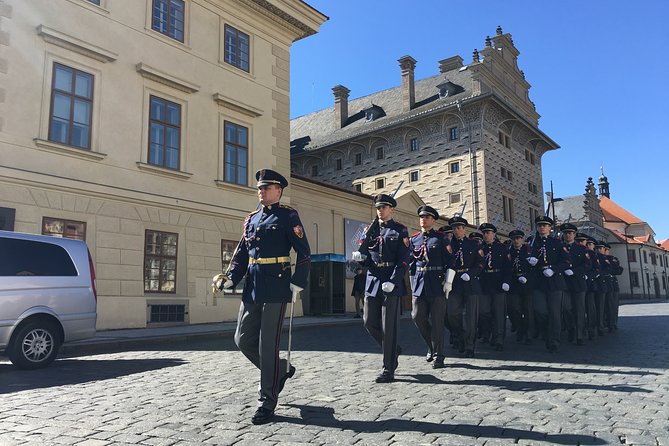
Also, on days where timing lines up, you might catch the changing of the guard around noon. Your guide is the one most likely to help you place that moment in your schedule.
What could disappoint you (and how to avoid it)
No tour is perfect, and this one has a few potential friction points.
You might expect more palaces, but the cathedral takes time
Because St Vitus Cathedral is central, the visit can feel cathedral-heavy. One negative take was that the group expected to see more palaces but spent more time in the cathedral—also with some areas under scaffolding and construction.
That doesn’t mean the tour is bad. It means your priorities should match the tour’s strengths: major landmarks, correct context, and efficient time use. If your dream is seeing every palace interior no matter the trade-offs, you may need a longer or different plan.
Schedules and closures can affect interior access
Another consideration is that real life happens. A cathedral can have a mass. An Old Royal Palace interior can be restricted due to events. In at least one case, a guide substituted a nearby option like Queen Anne’s Summer Place when the original stop wasn’t available.
So bring flexibility. The castle doesn’t care about your calendar. A good guide can help you protect your sightseeing time anyway.
Price means you should expect real added value
At this price, you should not feel like you’re simply buying “a person with a headset.” If you only want basic facts, a cheaper self-guided audio route might satisfy you.
But if you want the guide to:
- manage the flow,
- answer questions,
- and help you connect what you see,
then the price starts to make sense quickly—especially with admission included.
Who this tour fits best
This tour is especially good for:
- First-time Prague visitors who want the castle highlights without getting lost in details.
- People short on time who still want the deeper meaning behind the big names.
- Families who benefit from a patient guide and a flexible pace.
- Anyone who wants a private experience where you can ask questions without feeling rushed.
It can also work well as a first-day anchor. Once you understand the castle’s layout and the role it played for Czech rulers, the rest of Prague makes more sense.
Quick practical tips before you go
- Dress for walking on stone and stairs, and plan for weather. Even when it’s cold, you’ll still be outside between stops.
- If you can choose your time, mornings tend to be easier for crowds.
- Have your phone charged and your mobile ticket ready at the meeting point.
- If you’re traveling with kids, tell the guide early. Guides often adjust their explanations to keep questions coming.
Should you book this private Prague Castle walking tour?
If you want a smooth 3-hour plan through the core of Prague Castle—St Vitus Cathedral, Old Royal Palace interiors, Golden Lane, Daliborka, and St George’s Basilica—this is a strong choice. The private format, English guide, and admission-included stops are the big value drivers, and the praised guiding style (like fast routing and flexible pacing) is exactly what you need in a place this busy and this big.
I’d skip it if your priority is maximum palace count at any cost, or if you’re the type who prefers to wander and read quietly on your own. But if you want the castle to click fast—then yes, booking makes sense. Just be ready for a day that can shift slightly due to services or openings, and you’ll be in a good frame of mind.
FAQ
How long is the private Prague Castle walking tour?
It runs for about 3 hours.
Is this tour private or shared?
It’s private. Only your group participates.
What language is the tour offered in?
The tour is offered in English.
Where does the tour start and end?
It starts at Archbishop Palace 16, Hradčanské nám. 56, and it usually ends in Klárov.
What is included in the price?
A private tour guide is included, and entrance fees for Prague Castle sites are included in the tour.
Is food and drinks included?
No. Food and drinks are not included.
Do I need to print anything for the tickets?
You’ll have a mobile ticket.
What is the price per person?
The price is $169.38 per person.
Is there a cancellation option if plans change?
Yes. Free cancellation is available up to 24 hours before the experience’s start time for a full refund.