REVIEW · PRAGUE
Prague Essential Tour Old Town and Jewish Quarter
Book on Viator →Operated by Verneus Tours - Free Tour Praga · Bookable on Viator
Prague looks different when you walk it with a guide. This Old Town and Jewish Quarter tour is a fast, well-paced way to pick up names, dates, and meaning as you move from major landmarks to quieter memorial spaces. I especially like how it starts with orientation at Rudolfinum and then strings together big-picture stories that make the sights feel connected.
You’ll also get standout stops tied to real people, from the Astronomical Clock area to the Jewish Quarter’s synagogues and cemetery. One thing to consider: the walking time at each stop is short, and a couple of sights are marked as admission not included, so you may need to budget a bit extra if you want to go inside.
In This Review
- Key highlights you’ll actually feel during the walk
- Starting where the view and the story both begin: Rudolfinum and Jan Palach Square
- Old Town Square: St. Nicholas, the Jan Hus sculpture, and Prague’s civic heartbeat
- Týn Church at the skyline line: spotting the twin towers with context
- Old Town Hall and the Astronomical Clock: how to watch without getting lost
- Karolinum and Charles University: why the route includes Kafka, Tesla, and Einstein
- Estates Theatre and Mozart’s Don Giovanni: theater history you can feel in your feet
- Mihulka Powder Tower: a medieval gate idea that changes how you read the streets
- Franz Kafka statue at the Jewish quarter gates: literature meets place
- Spanish Synagogue and the Jewish Museum: Moorish style with meaning
- Old-New Synagogue: 13th-century continuity, not just a photo stop
- Old Jewish Cemetery: leaning tombstones and a respectful final note
- What the money buys you: a low price with real guide time
- Who should book this Prague Essential Old Town and Jewish Quarter walk
- Should you book this tour or skip it?
- FAQ
- How long is the Prague Old Town and Jewish Quarter tour?
- Is the tour offered in English?
- Where do I meet, and does the tour end at the same place?
- Are entrance tickets included for every stop?
- Do I get hotel pickup or food during the tour?
- Can I cancel for free?
Key highlights you’ll actually feel during the walk
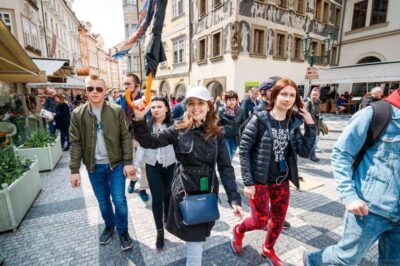
- Small group size (max 25) means you can hear the guide without yelling over the crowd
- Certified official guide in English keeps the stories clear and easy to follow
- Rudolfinum as the smart start point helps you get oriented quickly
- Astronomical Clock + Old Town Square gives you the medieval “center of gravity” in one pass
- Spanish Synagogue and Old-New Synagogue bring Jewish Prague into focus with architectural contrasts
- Old Jewish Cemetery adds a reflective ending that you usually miss on quick sightseeing days
Starting where the view and the story both begin: Rudolfinum and Jan Palach Square
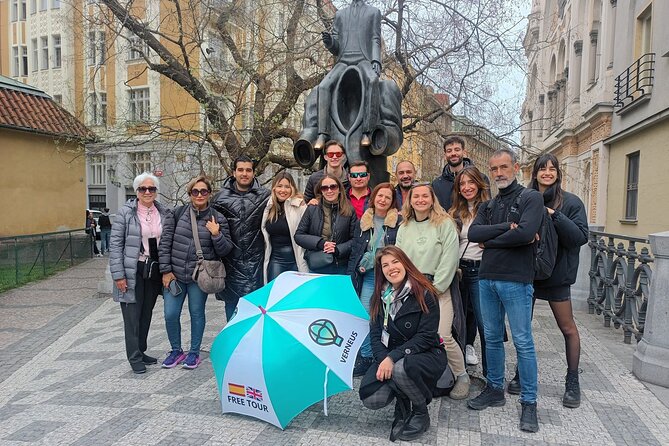
The meeting point is Jan Palach Square in Prague 1, and the tour ends back at the same spot. From there, the group gathers at the steps of the Rudolfinum, easy to find thanks to the White and Green umbrellas. That’s a small detail, but it matters: you don’t waste time hunting your group in a busy Old Town area.
This first segment is also about setup. The guide uses the location to give you a map in your head—where Old Town’s power centers were, and how the Jewish Quarter fits into the wider geography of Prague. It’s the kind of opening that makes the rest of the walk click instead of feeling like a checklist.
One practical note: Rudolfinum is one of the stops where the admission ticket is not included, so if you plan to go in, expect an extra cost. If your priority is the guide-led overview, you can still get a lot from the outside and the context.
You can also read our reviews of more tours and experiences in Prague.

Old Town Square: St. Nicholas, the Jan Hus sculpture, and Prague’s civic heartbeat
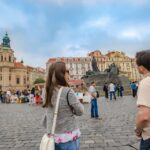
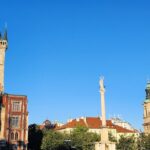
Next, you land at Staroměstské náměstí (Old Town Square), one of the most important public spaces in the city. This isn’t just about pretty buildings. You get a quick orientation to the characters and institutions that shaped Prague: the Baroque St. Nicholas Church, the Jan Hus sculpture, and the Gothic Town Hall.
I like Old Town Square most when it’s explained as a social stage. Here, the guide’s job is to connect what you see—styles, monuments, and street lines—to why the square mattered. If you’ve ever felt lost in Prague’s “wow, buildings” moments, this is the fix: you learn what to pay attention to.
Time is short (about 20 minutes), so you won’t linger for long photo loops. Still, it’s enough time to get your bearings and know what you’re looking at when you circle back on your own later.
Týn Church at the skyline line: spotting the twin towers with context
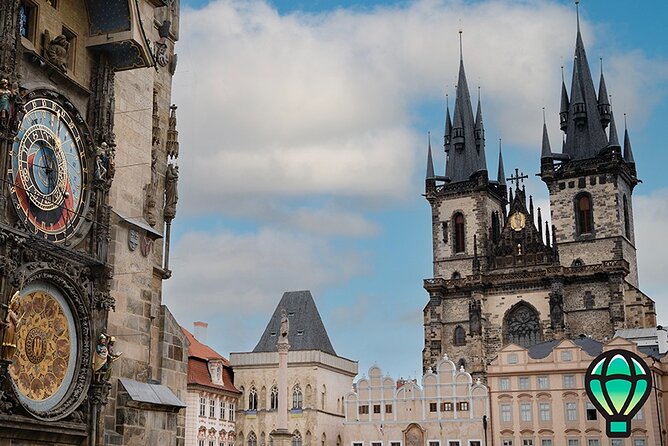
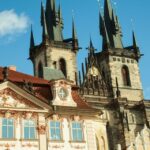
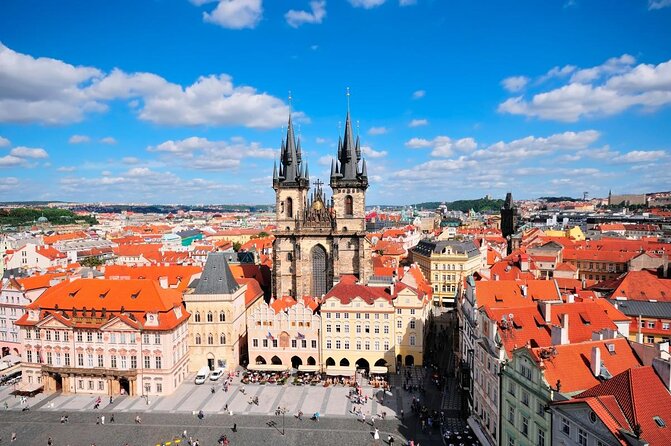
Then comes the Church of Our Lady before Týn (Týn Church). Even if you don’t go inside, those twin towers do the heavy lifting for you visually—they’re one of the most recognizable Prague silhouettes. The tour keeps this stop brief (about 10 minutes), which is right for a morning or afternoon when you still have synagogues and memorial time ahead.
What makes this stop worth the minute count is the framing. You learn how Týn Church fits into the broader Old Town view—how it anchors the skyline and becomes a landmark people use to orient themselves in the city. You’ll likely recognize it later from streets you didn’t expect.
If you want interior details, you’ll need to plan that separately. But for first-time Prague context, this quick exterior moment works well.
Old Town Hall and the Astronomical Clock: how to watch without getting lost
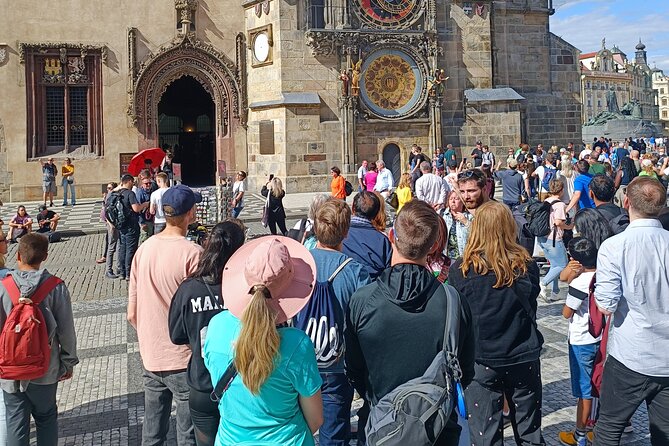
The Old Town Hall and Astronomical Clock stop is one of the central reasons people choose this kind of walk. Here, the tour focuses on the idea that the clock isn’t only about telling time. It also shows the movement of the stars and includes other surprises—so it reads like medieval science plus performance.
Expect about 15 minutes at this stop. That’s enough to understand what the clock is doing and why people crowd around it. It’s also enough to avoid the common mistake: staring without understanding the display.
Because the area is popular, you might find yourself working with a bit of crowd flow. The guide’s value is that you learn where to look and what to notice first, so you’re not just watching hands spin and hoping it makes sense later.
Karolinum and Charles University: why the route includes Kafka, Tesla, and Einstein
Next you reach Karolinum, home to Charles University, described here as the oldest in Central Europe. This is not a random campus photo stop. The point is that Prague isn’t only cathedrals and clocks—it’s also education and ideas.
The tour connects the university to famous names: Kafka, Tesla, and Einstein. Even if you already know some of these, it helps to place them in the geography of the city. You start to see Prague as a place where literature, invention, and learning shared the same urban space.
This stop is quick (about 10 minutes), but it’s a good tempo change. After the heavy visual landmarks, Karolinum gives you a different kind of Prague pride: the city’s mind-at-work side.

Estates Theatre and Mozart’s Don Giovanni: theater history you can feel in your feet
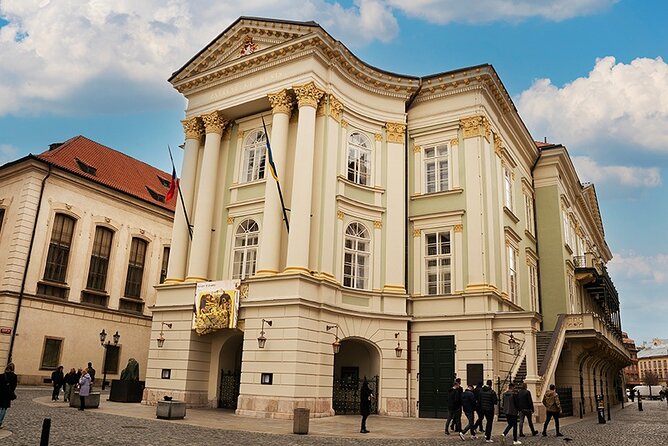
At The Estates Theatre, the tour points to a specific milestone: Mozart premiered Don Giovanni here in 1787. This is one of those details that makes a city feel personal. It’s not abstract history—you’re standing in a place tied to a work that still travels worldwide.
The stop lasts about 10 minutes, and the admission ticket is not included. So if you want to go inside, you’ll need to plan for that separately. For many people, the outside context and the guide’s story are enough to make the theater meaningful, especially with so many synagogue stops still ahead.
Mihulka Powder Tower: a medieval gate idea that changes how you read the streets
Then the tour shifts to the medieval edge of the city: Mihulka Powder Tower. The big value here is the connection to Prague’s past as a walled city with entry points. The tower is described as an old medieval structure that once functioned as one of the city entrance gates.
This stop also helps you start reading streets differently. When you learn something served as a gate, the city stops feeling like a grid of shops and starts feeling like a system. You’ll notice the way routes funnel and how older structures shape the flow.
Again, time is short (about 10 minutes). But it’s enough to plant an idea that pays off later as you walk.
Franz Kafka statue at the Jewish quarter gates: literature meets place
Right near the threshold of the Old Jewish Quarter, the tour includes a Franz Kafka statue stop. If you’re a Kafka reader, you already know he’s attached to Prague in a way that feels intimate. But the tour keeps it grounded: it explains the story behind why Kafka matters and where this connection lives in the city.
It’s a clever pause point too. After the Powder Tower, you’re moving closer to the Jewish Quarter’s emotional weight. The Kafka moment gives you a bridge between Prague’s intellectual image and its lived communities.
This stop is about 10 minutes and stays focused, which is helpful if your goal is to understand the neighborhood layout before you step deeper into the Jewish history sites.
Spanish Synagogue and the Jewish Museum: Moorish style with meaning
Now you enter the Jewish Quarter story proper, beginning with the Spanish Synagogue and the Jewish Museum in Prague. This stop is described as architecturally striking, built in Moorish style—a visual contrast that makes the building stand out immediately in Prague’s broader architectural mix.
The tour frames this as part of Jewish history in Prague, not just sightseeing. If your plan is to understand why certain buildings look the way they do, you’ll appreciate how the guide ties architecture to identity and community.
This stop is about 10 minutes, and the admission ticket is listed as free in the provided info. Still, check what you’re able to access on the day, because opening patterns and entry details can vary. Even if you don’t go deep inside, you can still learn a lot from the context and exterior details.
Old-New Synagogue: 13th-century continuity, not just a photo stop
The Old-New Synagogue is one of the most important stops on this route. It’s described as one of the oldest synagogues in Europe that still preserves worship, dating back to the 13th century. That’s the key idea: continuity. You’re not only seeing an antique structure; you’re seeing a place that remains meaningful.
You get about 10 minutes here. That’s short compared to visiting a museum at your own pace, but it’s enough to understand what makes this synagogue distinct and why it has such symbolic weight in the Jewish Quarter.
If you’re the type who likes to slow down for inscriptions and spaces, this stop may feel like it ends too fast. But with a tour like this, the goal is understanding first—then you can return later if the site calls you back.
Old Jewish Cemetery: leaning tombstones and a respectful final note
The last major site is the Old Jewish Cemetery, described as one of the most important points in the Quarter. The atmosphere here is unique, and the guide points out the famously leaning tombstones, which look unlike what many people expect from cemetery design.
This is your emotional landing zone. It’s also where the route stops being purely architectural and becomes human. A cemetery can feel uncomfortable if you rush it, so the guide’s pacing matters here.
This stop lasts about 10 minutes with admission listed as free. It’s not long, but it’s enough time to notice the details and absorb the mood without turning it into a speed photo session. Wear comfortable shoes—your brain may want to slow down, even when the schedule doesn’t.
What the money buys you: a low price with real guide time
The listed price is $3.62 per person for a tour that runs about 2 hours 30 minutes. On value alone, that’s hard to beat for an official guide plus a structured walk through major landmarks across two neighborhood themes.
The tour includes a certified official guide and about 2 hours 30 minutes of entertainment, meaning you’re paying for instruction, not just movement between points. The route also keeps most stops accessible: the provided info marks many admissions as free, while Rudolfinum and The Estates Theatre are the two spots marked as admission not included.
In plain terms: you’ll likely spend most of your money on your time and explanations, not entry fees. Still, if you want to go inside specific buildings, budget a little extra so you don’t hit the door and feel surprised.
Also, since there’s no hotel pickup or return transfer, you’ll want to arrive on your own and be ready to walk. This kind of tour works best when you treat it as your orientation day, then expand on your favorites later.
Who should book this Prague Essential Old Town and Jewish Quarter walk
This is a smart pick if you want:
- a structured way to understand Old Town Square and the Jewish Quarter without researching every street
- a guide-led route that hits big landmarks in a short time
- a balance of architecture, famous names, and place-based storytelling
It’s especially good for first-timers who don’t want Prague to feel like random stops. You’ll get enough explanation to return later with better questions.
If you’re someone who loves deep, unhurried museum time, this may feel tight. You’ll likely enjoy it most when you use it as a foundation, then schedule optional follow-ups on the sites that pull you in.
And yes, service animals are allowed, which can make planning easier.
Should you book this tour or skip it?
I’d book it if you want a guided framework for Old Town and Jewish Prague in one go. The guide-led structure is the advantage: you move through the city while learning what the landmarks mean, not just what they look like.
Skip or add extra time if you know you want lengthy interior visits, especially at the stops where admission isn’t included. Also, because the tour is about 2.5 hours, it’s best when you’re ready to keep moving and not expecting a half-day wandering pace.
If your goal is to see the essentials and understand why they matter, this one is a strong fit.
FAQ
How long is the Prague Old Town and Jewish Quarter tour?
It lasts about 2 hours 30 minutes.
Is the tour offered in English?
Yes, the tour is offered in English.
Where do I meet, and does the tour end at the same place?
You meet at Jan Palach Square, and the tour ends back at the meeting point.
Are entrance tickets included for every stop?
No. The Rudolfinum stop and The Estates Theatre are listed as admission ticket not included. Other listed stops show admission as free in the provided information.
Do I get hotel pickup or food during the tour?
No. Pick up and return to the hotel are not included, and food and drinks are not included.
Can I cancel for free?
Yes. Free cancellation is available up to 24 hours in advance for a full refund.